YouTube Taxes 2026: Where Creator Income Lands on Schedule C Line 1
This is education, not tax advice. I'm not a CPA or EA. State taxes are not covered.
Schedule C cited below is IRS draft as of 2026-10-07 — DRAFT, NOT FOR FILING. The information-return documents are read from the editions named in the source table (Instructions for Forms 1099-MISC and 1099-NEC, Rev. 12/2026; Instructions for Form 1099-K, 12/2026; IRS Fact Sheet FS-2025-08). If a line changes, this page is updated in place with a dated note at the foot of the article.
- Last checked
- Tax year
- 2026
- Core line
- Schedule C, line 1 — gross receipts or sales
- Changes
- Update log (2)
§1One job, one tax year, one line
One job, one tax year, one line. The job is solo creator — sponsorships on one side, platform payouts on the other. The year is 2026. The line is Schedule C's first line, line 1, where a business writes down everything it took in.
This article reads that line through the two documents that report a creator's money first. They are not two versions of one form: one reports what a single payer paid one person; the other reports gross transactions moved through a processor. Different paper, different tests — and both stop short of the line itself. What line 1 holds is decided by the creator's records; the documents are evidence, not the total.
§2Two documents, one line they both report to
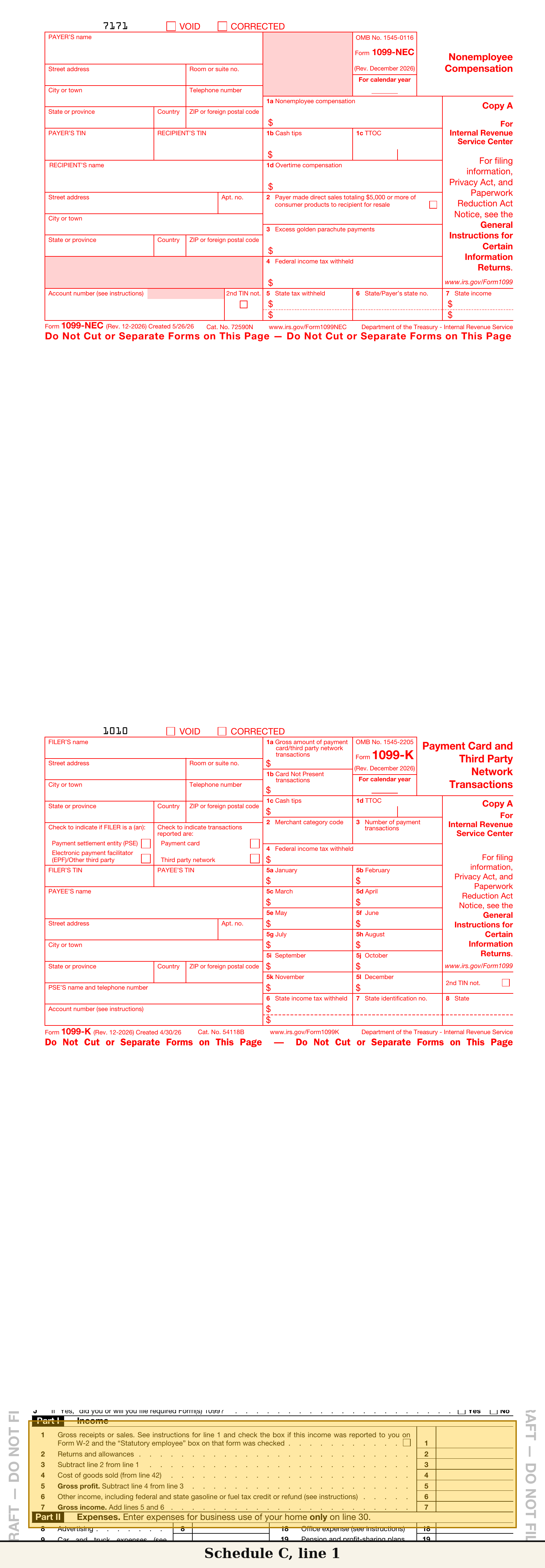
Start with what each document is for, because they answer different questions.
Form 1099-NEC is a payer's document. A business that pays a creator for a sponsorship fills it in and sends copies to the creator and the IRS: this payer paid this person this much for services, in this year.
Form 1099-K is a processor's document. A third-party settlement organization files it when its own test is crossed: this much gross money moved through us to this payee, in this many transactions.
Neither document is the return. Each is filed by somebody else and reaches only the payments its own filer handled. A creator with two sponsors and a platform has three payers or processors in the year; no single document describes the whole year.
Line 1 is where the whole year is written — gross receipts or sales, from the business's own records. The documents matter because the IRS already holds copies; the records matter because the full total exists only there. This article reads the documents first, one at a time, then watches their figures — plus one amount no document carries — enter line 1.
§3Document one: Form 1099-NEC, read as a document
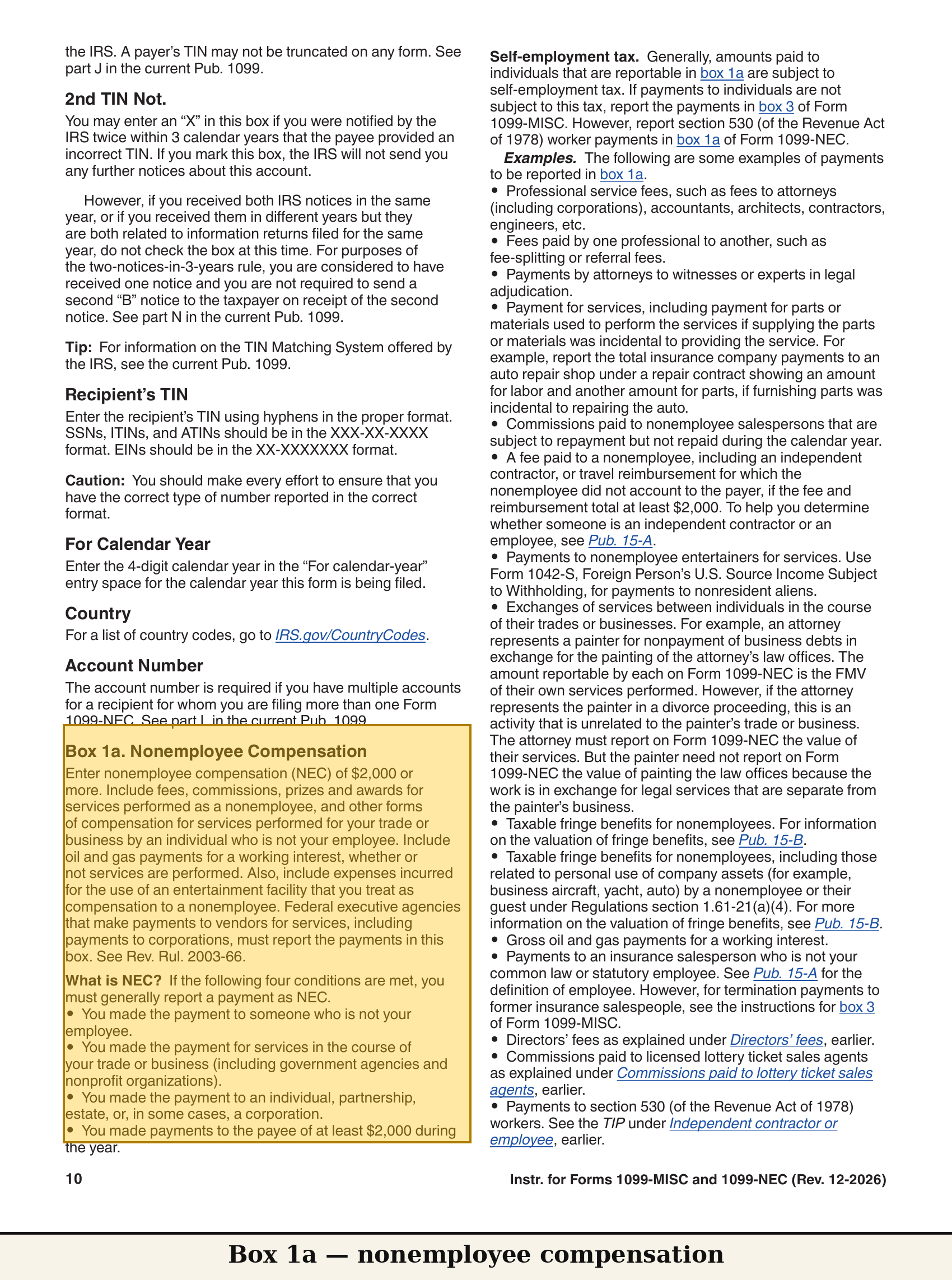
Instructions for Forms 1099-MISC and 1099-NEC capture — box 1 reporting conditions highlighted.
Document one: Form 1099-NEC.
Read box 1 off the payer's instructions. A payer reports nonemployee compensation of $2,000 or more, paid during the year, when the instructions' conditions are met: payment to a non-employee, for services in a trade or business, to an individual, partnership, estate, or certain corporations. Box 1 is the amount — what that payer paid that person.
Two things about that test. First, it is the payer's: the $2,000 is printed in the payer's instructions, and it decides whether this document is created and sent. Nothing on the creator's return is measured against it. Second, the test runs payer by payer: each sponsor measures only its own payments, and a sponsor under the line creates no document at all.
Hold that second point, because this article's example turns on it. A sponsorship fee of $1,800 from one brand sits under that brand's $2,000 test. No 1099-NEC is generated for it — no box anywhere prints $1,800. The amount exists in exactly one place: the creator's records. At line 1, that $1,800 will enter alongside the documented amounts — part of the same total, carried by the records because no document carries it.
§4Document two: Form 1099-K, read as a document
Document two: Form 1099-K — a different document, with a different test and a different box.
Box 1a, read from its own instructions: the gross amount of reportable payment transactions. Gross is the operative word: the figure is taken before fees, before refunds, before adjustments. Box 1a does not describe what the creator received; it describes what moved.
Whether it exists is decided by a two-part test, both parts of which must be crossed. A third-party settlement organization files only if the gross amount of reportable payments exceeds $20,000 and the number of transactions exceeds 200. Exceeds, on both sides — reaching either figure is not crossing it.
A figure from an earlier rule still circulates here, worth naming so it can be set aside: $600 — the figure from the repealed ARPA-era rule that the current fact sheet replaced, the fact sheet recording that the older, higher test was reinstated retroactively. $600 is not the test for these payments now.
One line kept apart, because it follows its own rule: payment-card transactions have no threshold at all — a Form 1099-K can arrive for card payments of any size — and that rule is not the settlement-organization test.
§5Worked example: the documents' figures enter line 1
One worked example, with numbers used only in this article.
A solo creator — hypothetical — finishes 2026 with three amounts, and the documents divide unevenly among them. A brand paid $6,500 for sponsorships — over that payer's $2,000 test, so a Form 1099-NEC exists and its box 1 reads $6,500. A second brand paid $1,800 — under that payer's test, so no document exists for it. The platform's processor moved $24,000 across the year; in this hypothetical its counts crossed both parts of the test, and the Form 1099-K shows $24,000 in box 1a.
Now the line. Line 1, gross receipts or sales, is built from the creator's records, which hold all three amounts: $6,500, plus $1,800, plus $24,000. Line 1 is $32,300. The documents agree with two of the three figures, but the total is the records' total, and the $1,800 stands in it at full size.
Below line 1, the form's own lines run. Line 2, returns and allowances: zero here, so line 3 is $32,300. Line 4, cost of goods sold: none in a sponsorship-and-platform year like this one, so line 5, gross profit, is $32,300. Line 6, other income: zero. Line 7, gross income — lines 5 and 6 added: $32,300.
One amount has not moved yet: the $2,350 the platform withheld in fees. It appears in no document's box and does not touch line 1. That is the fork.
| Document | What it prints | Amount | Where it enters Schedule C |
|---|---|---|---|
| Form 1099-NEC (Brand A) | Box 1: nonemployee compensation that payer paid — the payer's $2,000 test was crossed, so the document exists | $6,500 | Line 1, as part of gross receipts |
| No document (Brand B) | Nothing. The $1,800 fee sits under that payer's $2,000 test, so no form was generated; the amount exists only in the creator's records | $1,800 | Line 1, as part of gross receipts |
| Form 1099-K (platform processor) | Box 1a: gross amount of reportable payment transactions — before fees, refunds, and adjustments (both TPSO tests crossed in this hypothetical) | $24,000 | Line 1, as part of gross receipts |
| Schedule C, line 1 | Gross receipts or sales — the total from the creator's records | $32,300 | Line 1 |
| Returns and allowances | Line 2 | $0 | Line 3 = line 1 − line 2 = $32,300 |
| Cost of goods sold | Line 4 | $0 | Line 5 = line 3 − line 4 = $32,300 |
| Other income | Line 6 | $0 | Line 7 = line 5 + line 6 = $32,300 |
| Platform fees withheld — not printed in any document's box; read as an expense, not subtracted from line 1 (box 1a is gross, before fees) | — | $2,350 | Part II, line 10 (commissions and fees) — placement only; Part II is not totaled in this example |
§6The Fork: box 1a is gross; the fees land in Part II
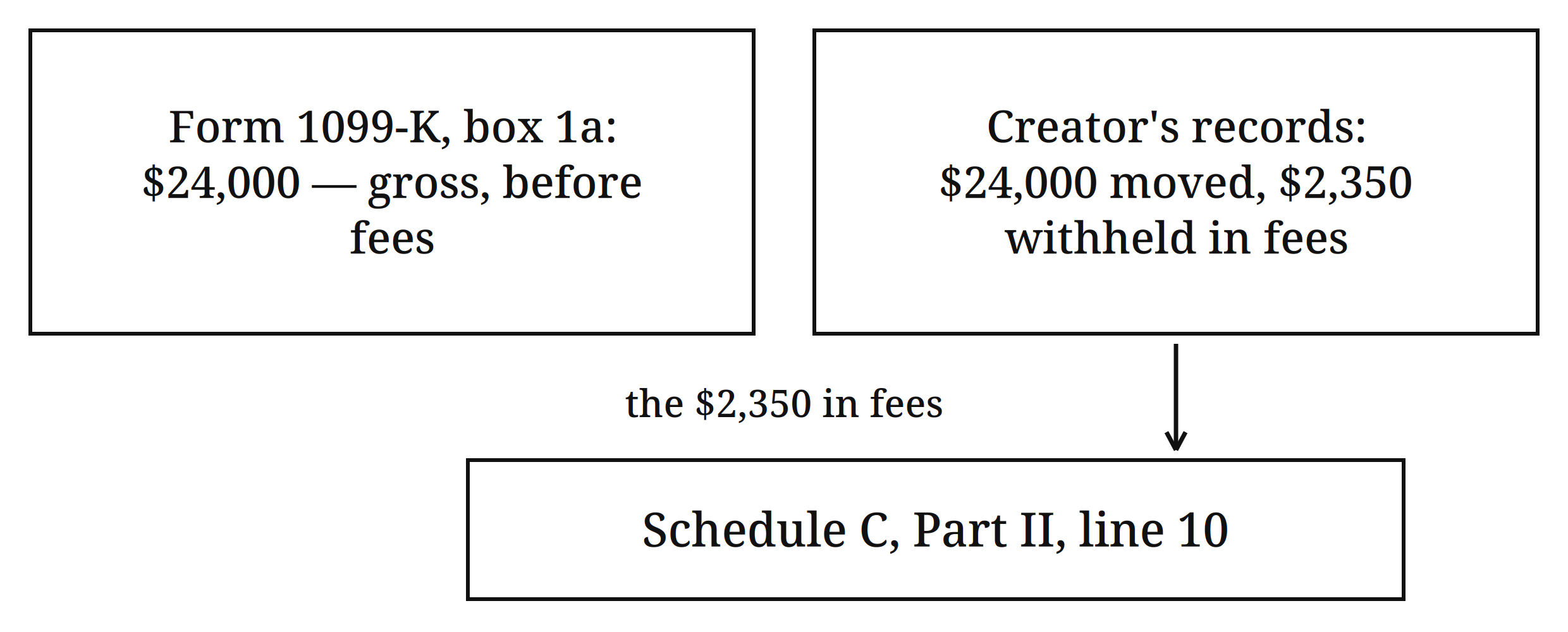
The fork sits inside the platform figure itself.
Box 1a reads $24,000, defined by its instructions as gross — before the platform's fees come out. The deposits tell a smaller story: $2,350 was withheld before the money arrived. Two true numbers, describing the same flow at different points in it.
Schedule C does not reconcile them by editing one of them. Line 1 takes the gross amount — the $24,000 stands inside the $32,300 — because the form's income side is built on gross receipts, the build box 1a's definition matches. The $2,350 is subtracted nowhere in Part I; Part I has no line for it.
The fees have their own place, further down the same form: Part II — in this example, line 10, commissions and fees. The whole $24,000 stands at the top; the whole $2,350 stands in the expense section; the form's own subtractions produce the net. This example stops at that placement: it does not total Part II, because a real creator year holds expense lines this article has not read, and a bottom line claimed here would claim more than the example contains.
In a 2026 Tax Court case, a creator with no influencer income yet claimed $97,505 of celebrity-event 'marketing' on Schedule C, and the court disallowed all of it as primarily personal.
§7What these forms do not cover
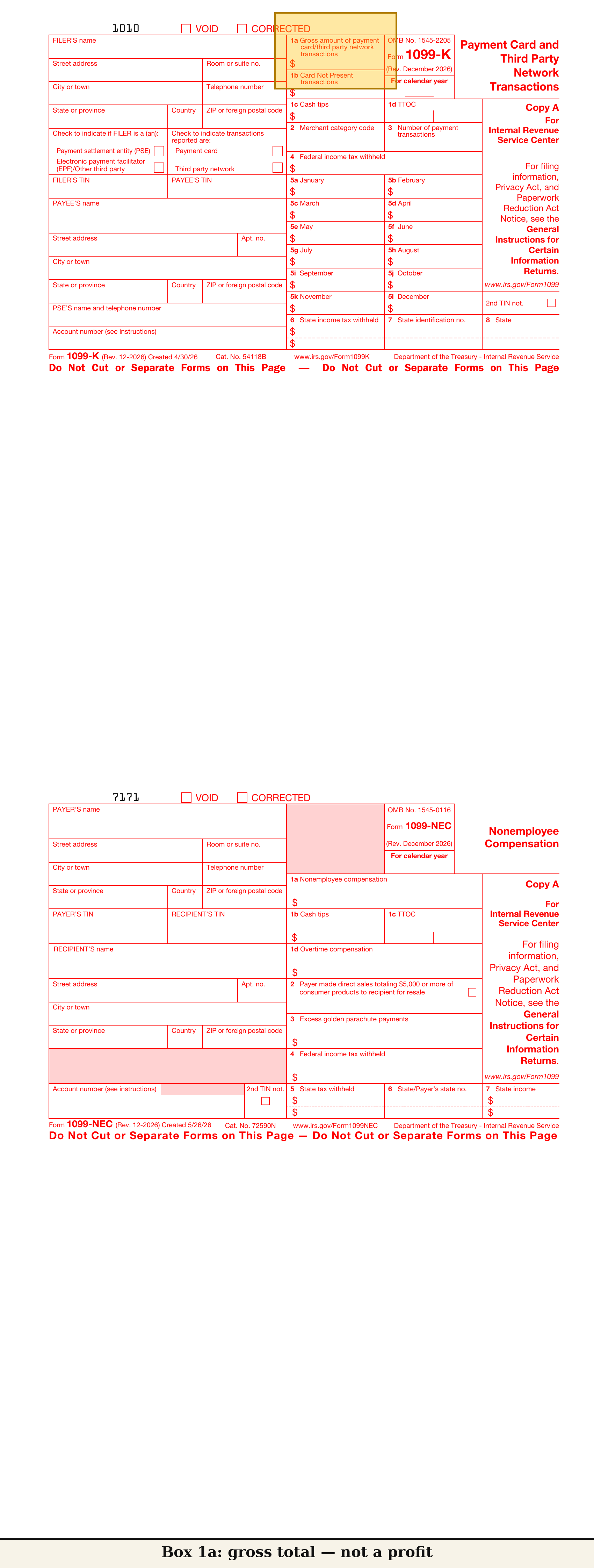
Form 1099-K and Form 1099-NEC captures, greyed, with callouts: "Box 1a: gross total — not a profit" / "1099-NEC: what one payer paid" / "State taxes: not covered".
What these forms do not cover, to close the reading.
Form 1099-K does not state a profit. Box 1a is a gross transaction total; the form does not sort which payments were business and which were not. Form 1099-NEC does not state a profit either; it reports what one payer paid, and only that payer's payments. Neither document decides how a payment mixing personal and business use is sorted; that sorting is printed on neither.
Schedule C does not finish the tax: its bottom line — net profit, line 31 — is carried to Schedule 1, where the return's income is totaled, and to Schedule SE, where a different tax is figured on it. Those are other articles' lines. Estimated payments across the year belong to Form 1040-ES and Publication 505. And state taxes are not covered — not by these documents as read here, and not by this site, in this article or any other.
§8What the arithmetic settles, and what it cannot
Last, the division this article has run on throughout: what the arithmetic settles, and what only the records behind it can.
Software settles the addition: given the three amounts — $6,500, $1,800, and box 1a's $24,000 — it totals line 1, runs Part I to line 7, and holds the $2,350 at line 10. The arithmetic is the form's; it is not where creator years go wrong.
The records questions go to a human. A box 1a that does not match the deposits is expected to differ — the box is gross — but how much of the difference is fees, how much refunds, and how much was never business income is a question about the records, not the addition. A payment reported under the wrong name or taxpayer number. A year where platform income and a W-2 job overlap, which other forms read in their own way.
So the creator's 2026 Schedule C rests on a simple division of labor: the documents fix two figures and define them — box 1 on one form, box 1a gross on the other — and the records supply everything else, including the amount no document carries. Line 1 holds $32,300 here; the $2,350 stands at line 10, an expense in Part II, never netted out of the top line. IRS draft as of October 7, 2026.
Next article: the designer and the consultant — clients on one side of Schedule C, a subcontractor on the other. Article 8
Sources
8 claimsEvery claim above traces to a document, a tax year, a line, and the date it was checked.
-
1
Form 1099-NEC, box 1 reports nonemployee compensation of $2,000 or more paid during the year, under the four conditions the instructions list (non-employee, trade or business services, paid to an individual/partnership/estate/some corporations, $2,000 or more in the year); prior line was $600 for payments before December 31, 2025
- DOC
- Instructions for Forms 1099-MISC and 1099-NEC; Publication 1099 threshold table (1099-NEC due January 31)
- YEAR
- Rev. 12/2026; Publication 1099 (2026)
- LINE
- Box 1 reporting conditions
- CHECKED
- 2026-10-07
-
2
A third-party settlement organization must file Form 1099-K only if gross reportable payments exceed $20,000 AND the number of transactions exceeds 200. FS-2025-08 records that this test is the pre-ARPA threshold, retroactively reinstated (OBBBA); the $600 figure still in circulation was the ARPA-era TPSO threshold that the fact sheet's test replaced. The same fact sheet and IRS pages state that reporting thresholds do not affect whether income is taxable
- DOC
- IRS Fact Sheet FS-2025-08 / IR-2025-107 (Oct 23, 2025); IRS "Understanding your Form 1099-K" pages
- YEAR
- 2025 fact sheet, current for 2026 payments
- LINE
- Threshold discussion
- CHECKED
- 2026-10-07
-
3
Payment-card transactions have no threshold — a Form 1099-K can arrive for card payments of any amount; kept separate from the third-party settlement organization test
- DOC
- FS-2025-08 / IR-2025-107; IRS Form 1099-K pages
- YEAR
- 2025
- LINE
- Payment card vs TPSO discussion
- CHECKED
- 2026-10-07
-
4
Form 1099-K, box 1a is the gross amount of reportable payment transactions — before fees, refunds, and adjustments
- DOC
- Instructions for Form 1099-K
- YEAR
- 12/2026
- LINE
- Box 1a
- CHECKED
- 2026-10-07
-
5
Schedule C Part I: line 1 gross receipts or sales; line 2 returns and allowances; line 3 = line 1 − line 2; line 4 cost of goods sold (from line 42); line 5 gross profit = line 3 − line 4; line 6 other income; line 7 gross income = line 5 + line 6
- DOC
- Schedule C (Form 1040) (2026 draft, posted 05/28/2026)
- YEAR
- 2026
- LINE
- Part I, lines 1–7
- CHECKED
- 2026-10-07 — IRS draft as of 2026-10-07
-
6
Schedule C Part II: line 10 is "Commissions and fees" — the expense line where the example reads the platform fees
- DOC
- Schedule C (Form 1040) (2026 draft, posted 05/28/2026)
- YEAR
- 2026
- LINE
- Part II, line 10
- CHECKED
- 2026-10-07 — IRS draft as of 2026-10-07
-
7
Schedule C line 31 (net profit) is carried to Schedule 1, line 3, and to Schedule SE, line 2 — named in this article only as the destinations this form feeds
- DOC
- Schedule C (2026 draft), line 31 text; Schedule 1 (2026 draft, posted 06/08/2026), line 3
- YEAR
- 2026
- LINE
- Schedule C line 31; Schedule 1 line 3
- CHECKED
- 2026-10-07 — IRS draft as of 2026-10-07
-
8
A creator with no influencer income yet claimed $97,505 of celebrity-event 'marketing' on Schedule C, and the court disallowed all of it as primarily personal
- DOC
- Sami v. Commissioner, T.C. Memo. 2026-69 (U.S. Tax Court, filed August 18, 2026; full text read for the case bank)
- YEAR
- Tax years at issue 2019–2021
- LINE
- Schedule C "other expenses" — "marketing events and marketing charity" ($42,762 + $38,806 + $15,937 = $97,505)
- CHECKED
- 2026-10-08
Update log
Changes are dated and kept. Old figures are never silently overwritten.