Safe Harbor Estimated Taxes 2026: The Fourth Payment, for Freelance Designers
This is education, not tax advice. I'm not a CPA or EA. State taxes are not covered.
Publication 505 (2026) cited below is a published edition, not a draft. The one draft capture used — Form 1040 (2026 draft, posted 09/17/2026) — is labeled IRS draft as of 2026-10-07 — DRAFT, NOT FOR FILING. If a line changes, this page is updated in place with a dated note at the foot of the article.
- Last checked
- Tax year
- 2026
- Core line
- Publication 505, Worksheet 2-1, line 12c
- Changes
- Update log (1)
§1One job, one tax year, one line
The job is freelance designer and consultant. The year is 2026. The line is line 12c of the Estimated Tax Worksheet — Worksheet 2-1 in Publication 505 — the required annual payment.
Article 1 read this same worksheet for a real estate agent making a first payment in the spring. This article reads the other end of the year: the fourth payment, and the comparison at lines 12a and 12b that produced line 12c. Different job, different numbers.
§2Where the fourth payment sits
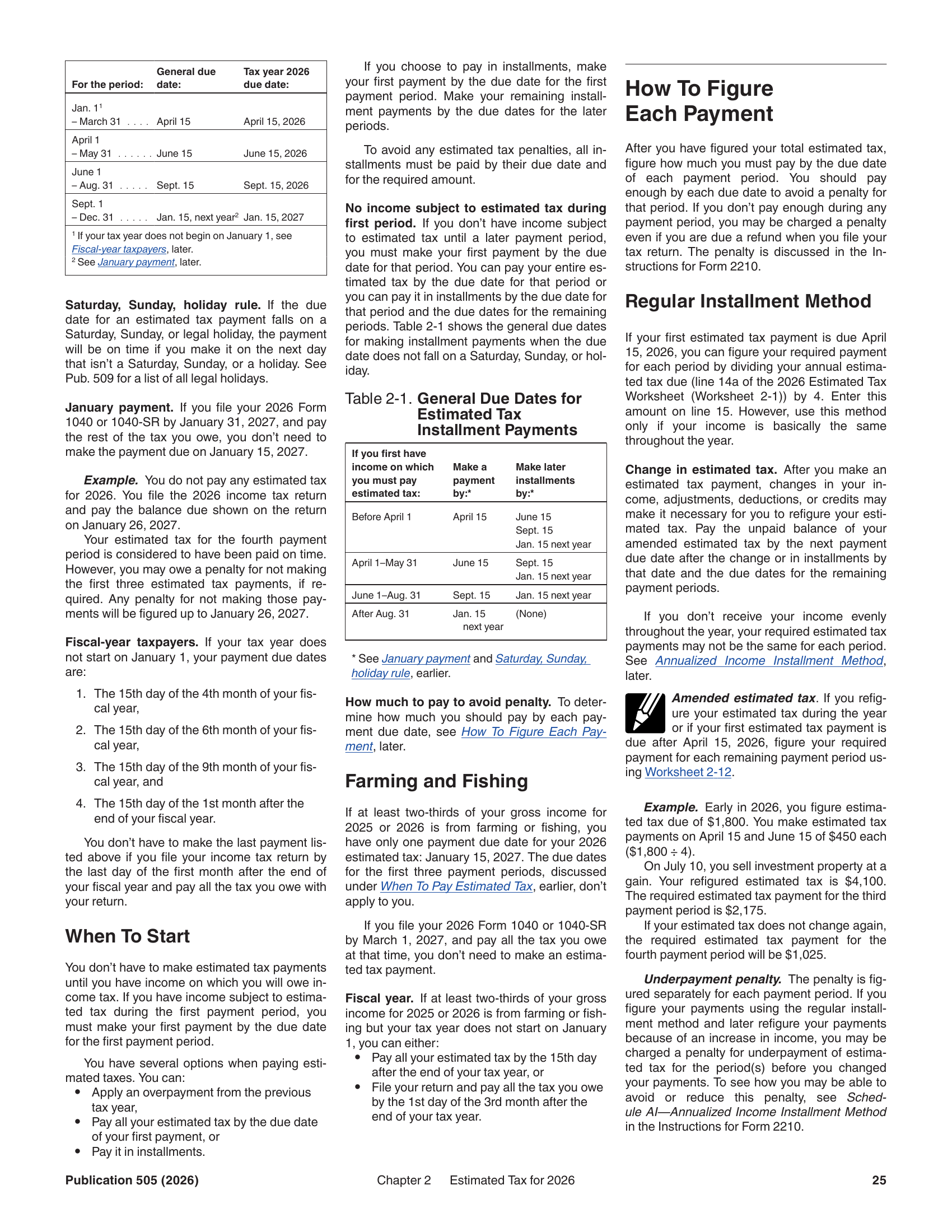
Publication 505 (2026), Ch. 2 — the four payment dates in a row: Apr 15 / Jun 15 / Sep 15 / Jan 15, 2027, with the four periods under them: 3 months, 2 months, 3 months, 4 months.
Publication 505, chapter 2, prints four payment dates for 2026: April 15, June 15, September 15, and January 15, 2027. The periods behind them are not equal — three months, two months, three months, four — and the fourth period runs September 1 through December 31.
This article is about the last of those dates. By the time it arrives, three payments are already made and the year they were estimating is closed. What remains is a single question the worksheet answered in advance: how much was required for the year, in total. That answer is built at lines 12a, 12b, and 12c, before any payment is subtracted.
So read the worksheet at the seam where it stops describing the year and starts comparing two versions of it. Line 12a looks forward, at the year just ended. Line 12b looks backward, at the year before it. Line 12c takes the smaller of the two — and that smaller figure, not either input on its own, is the required annual payment this article is locked to.
One identity worth stating before the lines are read: this worksheet, Worksheet 2-1 in the publication, is the estimated tax worksheet itself — the same worksheet printed for figuring the payments that the Form 1040-ES vouchers carry.
§3Reading lines 12a, 12b, and 12c

Worksheet 2-1 zoomed on lines 12a–12c. The 110% substitution text on line 12b's instruction highlighted.
Line 12a reads: 90 percent of the tax shown on your 2026 return. Read the structure of that. When these payments are figured, there is no 2026 return yet — so the input to line 12a is an expected figure, the current estimate of the full year's tax. It is a percentage of a number that is still moving.
Line 12b reads: 100 percent of the tax shown on your 2025 return. That input is the opposite kind of figure. The 2025 return exists. It was filed. The tax on it is a fixed, printed number, and line 12b takes all of it.
Then line 12b's instruction carries a substitution keyed to one figure on that filed return: when 2025 adjusted gross income exceeded $150,000, the multiplier becomes 110 percent rather than 100 — and on a married-filing-separately return, the printed threshold in that test is $75,000. The line does not ask why. It swaps the multiplier when the printed income test is met.
Line 12c is one operation: enter the smaller of line 12a or line 12b. Nothing else enters at 12c — no payments, no withholding; those come later, at lines 13 through 15. Line 12c is purely the comparison's result: the smaller of a percentage of this year's expected tax and a percentage of last year's filed tax. Hold the two inputs apart, because the worked example turns on exactly this difference.
§4Worked example, part 1: the comparison
One worked example, with numbers used only in this article.
A freelance designer and consultant — hypothetical inputs, not a prediction, not your numbers. Expected tax for 2026: $28,400. Tax shown on the 2025 return: $24,900. And one more input the worksheet asks for before line 12b can be read: 2025 adjusted gross income was over $150,000. The substitution applies.
Line 12a: 90 percent of $28,400 is $25,560.
Line 12b: the 2025 tax is $24,900, but the percentage is not 100 — the income test replaces it with 110. $24,900 times 110 percent is $27,390.
Now the comparison, because line 12c is only a comparison. $25,560 against $27,390. The smaller is $25,560 — line 12a's figure. Line 12c, the required annual payment, is $25,560.
Read what just happened, because it is the point of the example. The prior-year basis is the fixed one, as an input — that return is already filed. But its printed percentage moved, and the move changed the outcome. At 100 percent, line 12b would have read $24,900, and $24,900 would have been the smaller figure. At the printed 110 percent, it reads $27,390, and the current-year basis — a percentage of a tax that was still an estimate when the payments began — is the one that lands on line 12c. Neither basis was chosen. The worksheet compared two printed computations and took the smaller.
§5The Fork: a moving basis against a fixed basis
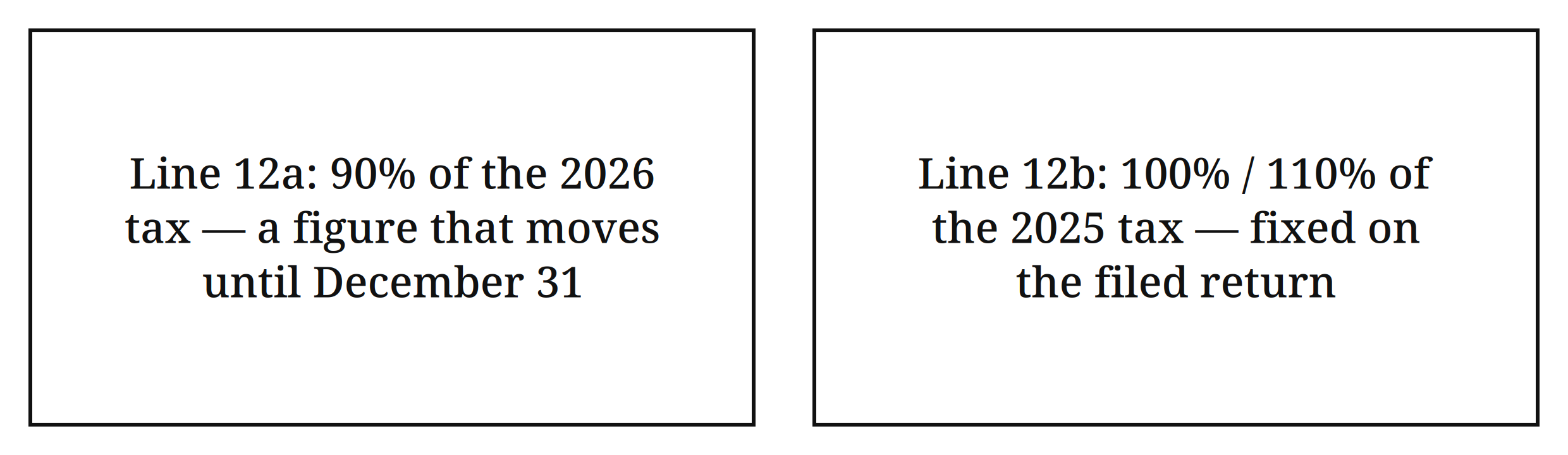
Split card — Line 12a: 90% of the 2026 tax — a figure that moves until December 31; Line 12b: 100% / 110% of the 2025 tax — fixed on the filed return.
This is the fork in this article, and it is narrower than it looks.
The two safe-harbor bases differ in one structural way: what kind of number feeds them. Line 12a's basis, 90 percent of the current year's tax, is not final until the year ends and the return is figured. Every change in the year's income moves it — including income that arrives in December, after three of the four payments are already made. A consultant whose largest invoice lands in the fourth quarter is feeding line 12a with a figure that was not knowable in April.
Line 12b's basis, 100 percent or the substituted 110 percent of the prior year's tax, was fixed the day the prior return was filed. It cannot move during 2026 at all. Its only moving part is the substitution, decided by one printed income test on a return that already exists.
The worksheet does not weigh these qualities. It does not ask which basis tracks the year better. It prints two computations and takes the smaller — and the example just showed the smaller one can be either, depending on the percentages the form itself substitutes. Which basis is smaller in a given year is arithmetic, not a strategy. That is the whole fork.
§6Worked example, part 2: lines 13 through 15, and what is left
Return to the example, below line 12c.
Line 13 reads in the year's withholding — amounts that stand against the required annual payment before any installment is figured. This example carries $3,000 on line 13.
Line 14a: line 12c minus line 13. $25,560 minus $3,000 is $22,560 — the amount the year's installments are built from.
Before any division, the worksheet asks its printed question at line 14b: line 11c minus line 13 — $28,400 minus $3,000 is $25,400. Is the result less than $1,000? It is not, so the worksheet goes on to line 15.
Line 15 divides line 14a by four. The regular installment method does not weight the periods — the income periods run three, two, three, and four months, but the payments this worksheet prints are equal: $22,560 divided by four is $5,640 per installment.
Count the year on that basis. The first three installments, April, June, and September, are $5,640 each: $16,920 paid. What remains on this worksheet path for the fourth date is one more installment of $5,640, due January 15, 2027.
One structural line belongs to this arithmetic: an underpayment on any single period is figured separately, period by period, on Form 2210 — the form Article 4 read, whose Schedule AI carries the annualized method for uneven income. Settling the fourth period in full leaves the first three exactly where their own computations put them — each period stands or falls on its own figures.
| Step | Worksheet 2-1 line | Operation | Amount |
|---|---|---|---|
| Expected tax for 2026 | Input to line 12a | Hypothetical input | $28,400 |
| Current-year basis | Line 12a | $28,400 × 90% | $25,560 |
| Tax shown on the 2025 return | Input to line 12b | Hypothetical input; 2025 AGI was over $150,000 | $24,900 |
| Prior-year basis, with the printed substitution | Line 12b | $24,900 × 110% (110% replaces 100% because the 2025 AGI test is met) | $27,390 |
| For comparison only — not a worksheet line | — | What line 12b would read at 100%: $24,900 × 100% — it would have been the smaller figure | $24,900 |
| Required annual payment | Line 12c | Smaller of line 12a ($25,560) or line 12b ($27,390) | $25,560 |
| Withholding for the year | Line 13 | Hypothetical input | $3,000 |
| Amount the installments are built from | Line 14a | $25,560 − $3,000 | $22,560 |
| $1,000 test | Line 14b | Line 11c − line 13: $28,400 − $3,000 = $25,400 — not less than $1,000, so the worksheet continues to line 15 | $25,400 |
| Each installment, regular method | Line 15 | Line 14a ÷ 4: $22,560 ÷ 4 — equal installments, unequal periods | $5,640 |
| Paid across Q1–Q3 (Apr 15, Jun 15, Sep 15, 2026) | — | 3 × $5,640 | $16,920 |
| Remaining for the fourth date, January 15, 2027 | — | 1 × line 15 | $5,640 |
§7What this worksheet does not cover
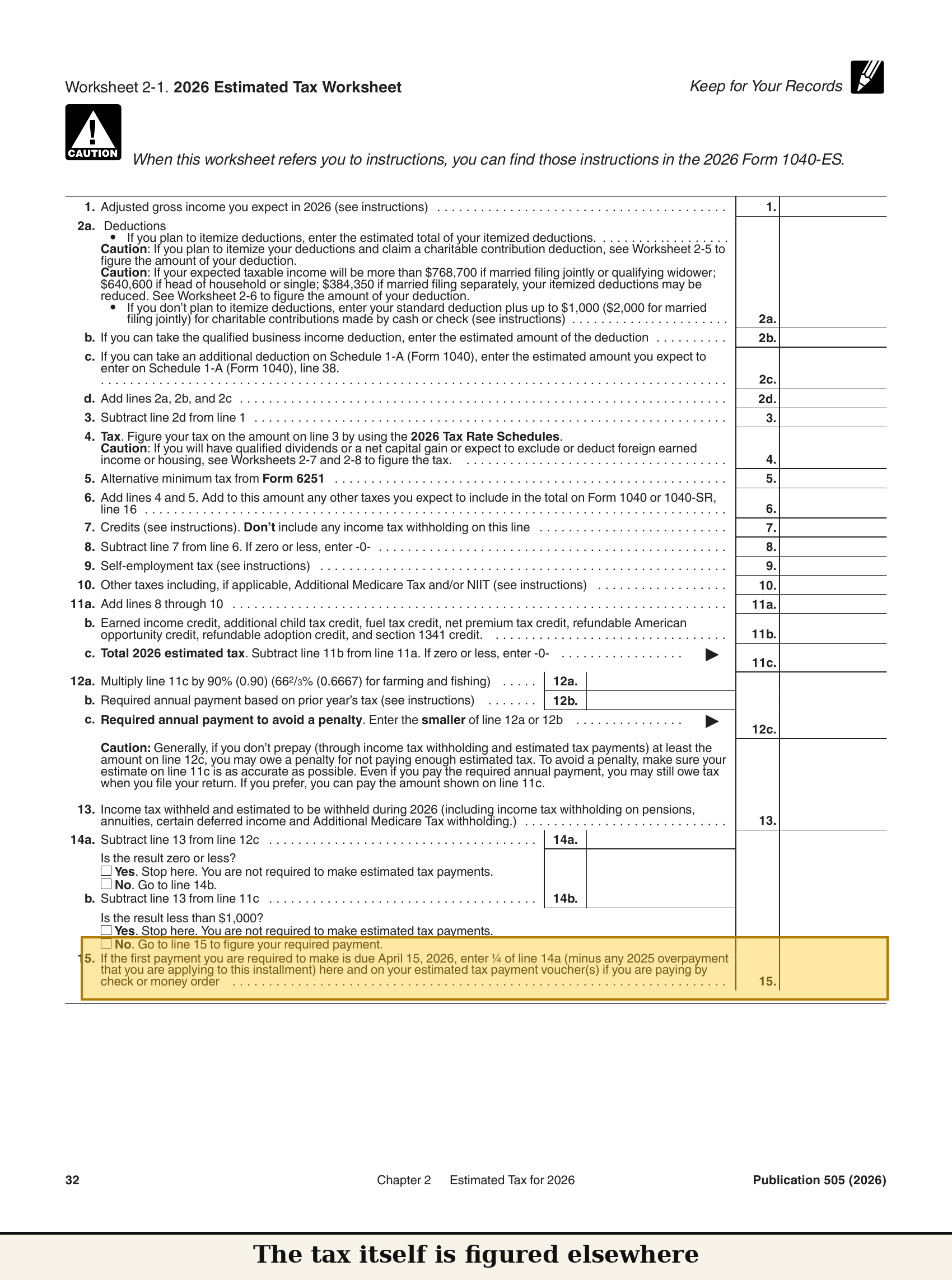
Worksheet 2-1 full page, greyed, with three callouts: "The tax itself is figured elsewhere" / "Annualized method: Form 2210, Schedule AI — Article 4" / "State taxes: not covered".
What this worksheet does not do, to close the reading.
It does not figure the tax itself. Lines 12a and 12b take tax figures as inputs; the year's income tax and self-employment tax are computed on their own forms, in other articles. It does not annualize: working with income that arrived unevenly is the annualized method's worksheet, not this one's equal quarters. It does not record a payment: the January 15 date is met with a Form 1040-ES voucher, and the year's payments are then entered on the return itself — line 26, on the 2026 draft of Form 1040. And it does not touch state estimated payments. State taxes are not covered.
One door this worksheet also does not open: the January 31 filing exception was Article 1's close, and it is pointed back to here, not re-read.
Software numbers vs ask-a-human numbers. What a program can carry, once the inputs are in front of it: the two percentage computations at lines 12a and 12b, the smaller-of comparison at 12c, the subtraction at 14a, and the division at line 15.
Numbers to take to a human before relying on them: the expected 2026 tax that feeds line 12a, because the worksheet accepts it as an input and cannot test whether the estimate is realistic; whether the $150,000 test is met on the 2025 return as filed, because that one input swaps line 12b's percentage; and any year where income arrived unevenly enough that the annualized method is in play, since that is a different form's worksheet entirely.
That is line 12c at the fourth payment: two bases printed, the smaller taken — $25,560 in this article's example — four equal installments of $5,640 built under it, and the last one due January 15, 2027.
Next article: Form 2553 Deadline 2026 — the 2 months and 15 days rule, read from the instructions. Article 12
Sources
5 claimsEvery claim above traces to a document, a tax year, a line, and the date it was checked.
-
1
Four payment dates for 2026 — April 15, June 15, September 15, 2026, and January 15, 2027; periods Jan 1–Mar 31, Apr 1–May 31, Jun 1–Aug 31, Sep 1–Dec 31 (3/2/3/4 months)
- DOC
- Publication 505, Tax Withholding and Estimated Tax, Ch. 2
- YEAR
- 2026
- LINE
- Ch. 2 payment-period table
- CHECKED
- 2026-10-06
-
2
Line 12a = 90% of the tax shown on the 2026 return; line 12b = 100% of the tax shown on the 2025 return, with 110% substituted if 2025 AGI was over $150,000 ($75,000 if married filing separately); line 12c = the smaller of 12a or 12b (required annual payment)
- DOC
- Publication 505 (2026), Worksheet 2-1 (Estimated Tax Worksheet)
- YEAR
- 2026
- LINE
- Worksheet lines 12a, 12b, 12c
- CHECKED
- 2026-10-06
-
3
Line 13 = withholding for the year; line 14a = line 12c minus line 13; line 14b = line 11c minus line 13, the printed $1,000 test; line 15 = line 14a divided by 4 — the regular installment method produces four equal installments even though the income periods are unequal
- DOC
- Publication 505 (2026), Worksheet 2-1
- YEAR
- 2026
- LINE
- Worksheet lines 13, 14a, 14b, 15
- CHECKED
- 2026-10-06; mapping corrected 2026-10-07
-
4
Underpayment for any period is figured separately, period by period, on Form 2210; the annualized income method lives on Form 2210, Schedule AI (read in full in Article 4)
- DOC
- Publication 505 (2026), Ch. 2; Instructions for Form 2210 (2025, latest posted)
- YEAR
- 2026 / 2025
- LINE
- Ch. 2; Form 2210 Parts I–III structure
- CHECKED
- 2026-10-06
-
5
The year's estimated payments are entered on Form 1040 at line 26, "2026 estimated tax payments and amount applied from 2025 return" (closing reference only)
- DOC
- Form 1040 (2026 draft, posted 09/17/2026)
- YEAR
- 2026
- LINE
- Line 26
- CHECKED
- 2026-10-06 — IRS draft as of 2026-10-07
Update log
Changes are dated and kept. Old figures are never silently overwritten.