Realtor Car Expenses 2026: The Split Mileage Rate on Schedule C Line 9
This is education, not tax advice. I'm not a CPA or EA. State taxes are not covered.
Schedule C cited below is IRS draft as of 2026-10-07 — DRAFT, NOT FOR FILING. If a line changes, this page is updated in place with a dated note at the foot of the article.
- Last checked
- Tax year
- 2026
- Core line
- Schedule C, line 9 — car and truck expenses; with Part IV, lines 43–47b
- Changes
- Update log (1)
§1One job, one tax year, one line
One job, one tax year, one line. The job is real estate agent. The year is 2026. The line is Schedule C, line 9 — car and truck expenses — and the short section behind it, Part IV, where the form asks what the car actually did all year.
Line 9 holds a single amount. But 2026 gives that amount an unusual build when it comes from miles: the price of a business mile is one number for the first half of the year and a different number for the second half. This article reads the line, the two printed prices, and the mileage split the form demands behind them.
§2Where line 9 sits
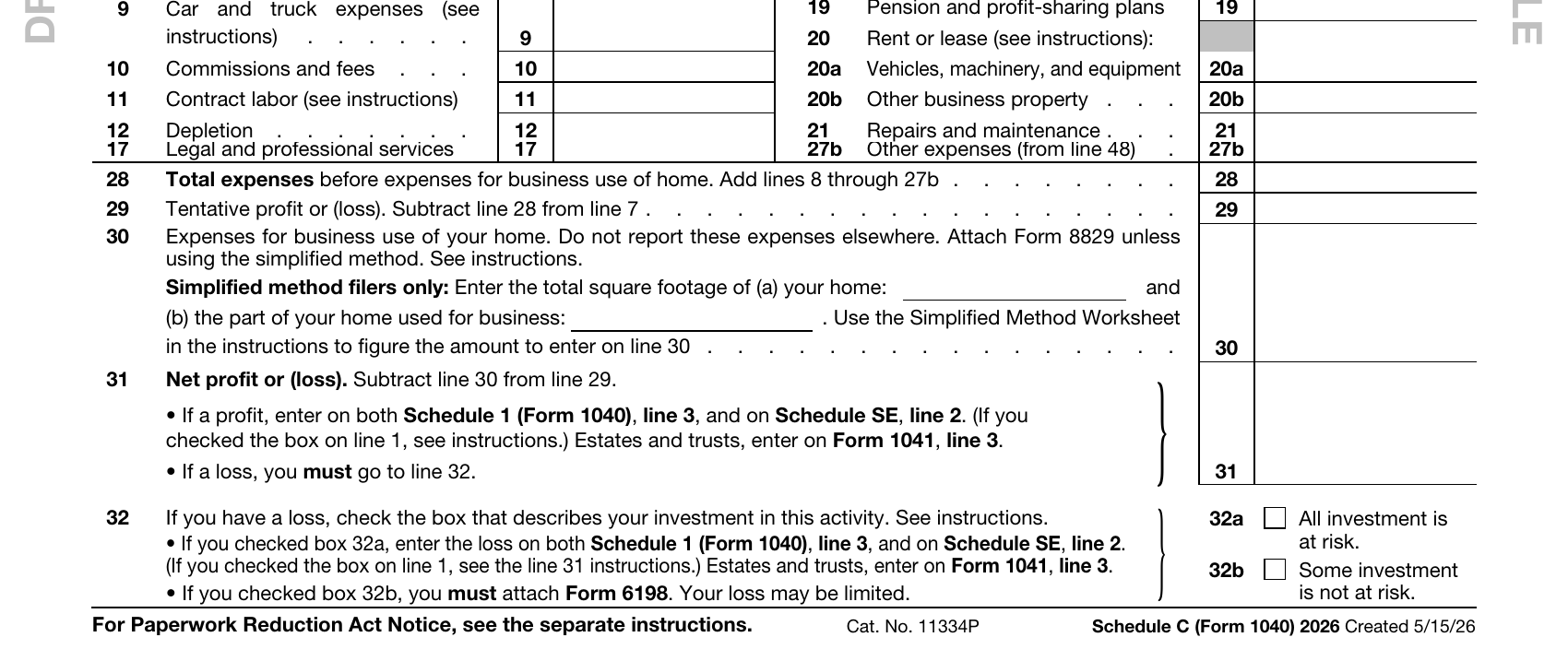
Line 9 sits near the top of Part II, the expense section of Schedule C, at car and truck expenses. It is one entered amount among the expense lines that total at line 28, flow through tentative profit at line 29, and come out as net profit at line 31 — the figure Schedule 1, line 3, and Schedule SE, line 2, both read.
What makes line 9 different from its neighbors is that the form does not leave it alone. Further down the same form sits Part IV, Information on Your Vehicle, and its printed condition is narrow: it is completed only if line 9 is being claimed and the filer is not required to file Form 4562. Line 43 asks when the vehicle was placed in service. Lines 44 through 47b ask how the vehicle was used and what evidence stands behind the claim.
So the architecture is two-part: a single dollar figure at line 9, and a set of questions behind it that the same form insists on. The dollars are read first — because in 2026, the dollars have a seam in the middle.
§3The 2026 rate: a price that changes mid-year
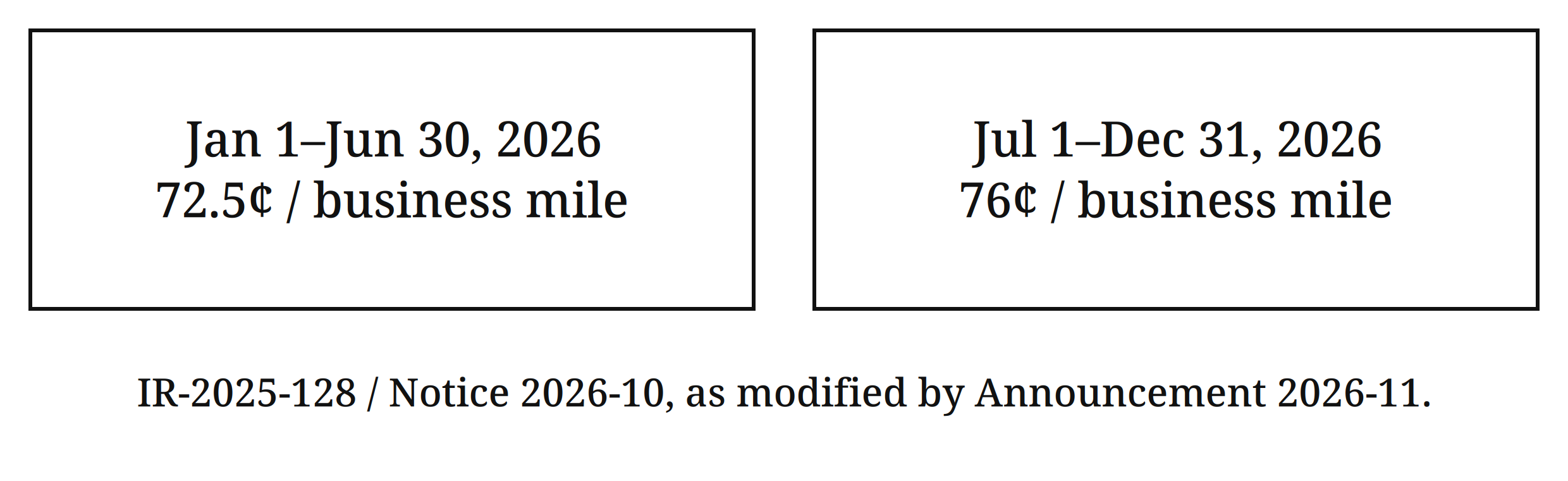
Two-rate card — Jan 1–Jun 30, 2026: 72.5¢ / business mile; Jul 1–Dec 31, 2026: 76¢ / business mile. Source: IR-2025-128 / Notice 2026-10, as modified by Announcement 2026-11.
The Internal Revenue Service prices a business mile each year, and for 2026 it priced the year in two pieces. The announcement — IR-2025-128, carrying Notice 2026-10, later modified by Announcement 2026-11 — prints the standard mileage rate for business use as 72.5 cents per mile for January 1 through June 30, and 76 cents per mile for July 1 through December 31.
Read what that does to the calendar. A mile driven to a showing in March is priced at 72.5 cents. The same mile, to the same showing, in September is priced at 76 cents. The rate does not average the year, and the form asks for no separate line per half — the split lives inside the build of the line 9 amount, which means the year's business miles have to be known in two piles before line 9 can be figured by this route at all.
That is the first thing the 2026 rate asks of a first-year agent: not a total, but a total with a date seam at June 30.
§4Worked example: 11,600 business miles, priced in two halves
One worked example, with numbers used only in this article.
A real estate agent — hypothetical, not a prediction, not your numbers — drives for the business all through 2026, and the year's record separates the business miles the way the rate splits the year.
First half: 6,200 business miles between January 1 and June 30. At 72.5 cents a mile — 6,200 times $0.725 — that is $4,495.00.
Second half: 5,400 business miles between July 1 and December 31. At 76 cents a mile — 5,400 times $0.76 — that is $4,104.00.
Add the two halves: $4,495.00 plus $4,104.00 is $8,599.00. That is the amount this example enters at line 9, built entirely from the standard mileage rate — nothing else enters line 9 in this example; the rate build is the amount.
Hold the shape of it, not just the total. The same 11,600 business miles priced at one flat rate would be a different number; 2026 does not offer one flat rate. Every mile is priced by the half of the year it was driven in, and the two multiplications are the whole build.
| Step | Source line | Operation | Amount |
|---|---|---|---|
| Business miles, Jan 1–Jun 30, 2026 | Hypothetical input | Invented for this article | 6,200 miles |
| First-half rate | Notice 2026-10, as modified | Printed business standard mileage rate | $0.725 / mile |
| First-half amount | Build | 6,200 × $0.725 | $4,495.00 |
| Business miles, Jul 1–Dec 31, 2026 | Hypothetical input | Invented for this article | 5,400 miles |
| Second-half rate | Notice 2026-10, as modified | Printed business standard mileage rate | $0.76 / mile |
| Second-half amount | Build | 5,400 × $0.76 | $4,104.00 |
| Standard-mileage amount entered on Schedule C | Line 9 | $4,495.00 + $4,104.00 | $8,599.00 |
| Part IV — business miles (the only miles the rate touches) | Line 44a | 6,200 + 5,400 | 11,600 |
| Part IV — commuting miles (shown so the split is visible; not priced) | Line 44b | Hypothetical input | 1,900 |
| Part IV — other miles (shown so the split is visible; not priced) | Line 44c | Hypothetical input | 2,300 |
| Part IV — total miles accounted for | Lines 44a + 44b + 44c | 11,600 + 1,900 + 2,300 | 15,800 |
§5Part IV: the questions behind the amount, and one case
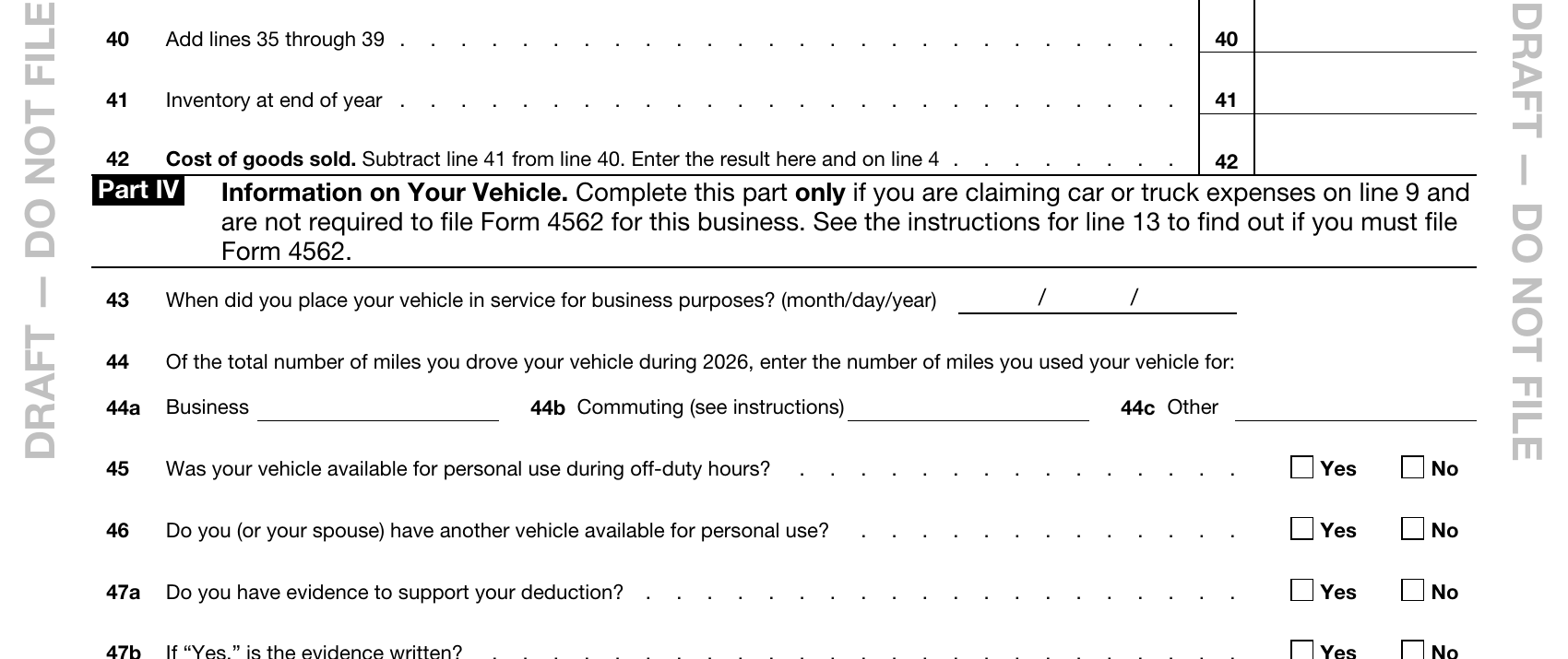
Behind the $8,599 sits Part IV, and Part IV does not ask about dollars at all. It asks about miles — all of them.
Line 44 takes the vehicle's driving for the year and splits it three ways, in print: line 44a, business miles; line 44b, commuting miles; line 44c, other miles. In this article's example, the entries read: 44a, 11,600 business miles — the same miles the rate was applied to; 44b, 1,900 commuting miles; 44c, 2,300 other miles. Together they account for 15,800 miles driven in the year, and the rate touched only the 44a pile.
The remaining questions are about use and proof. Line 45: was the vehicle available for personal use during off-duty hours. Line 46: was another vehicle available for personal use. Line 47a: is there evidence to support the deduction. Line 47b: is the evidence written.
Why does the form insist on the three-way split? In one Tax Court case — a summary opinion, Craddock, decided in 2023, which by statute is not precedent for any other case — car and truck expenses of $14,710 were denied in full: the mileage log the taxpayer kept never separated business miles from personal miles, and its entries conflicted with his bank records, and the strict substantiation rule blocked the court from estimating an amount in its place. The split Part IV prints at 44a, 44b, and 44c is exactly the split that log never made.
§6The Fork: two builds for the same line
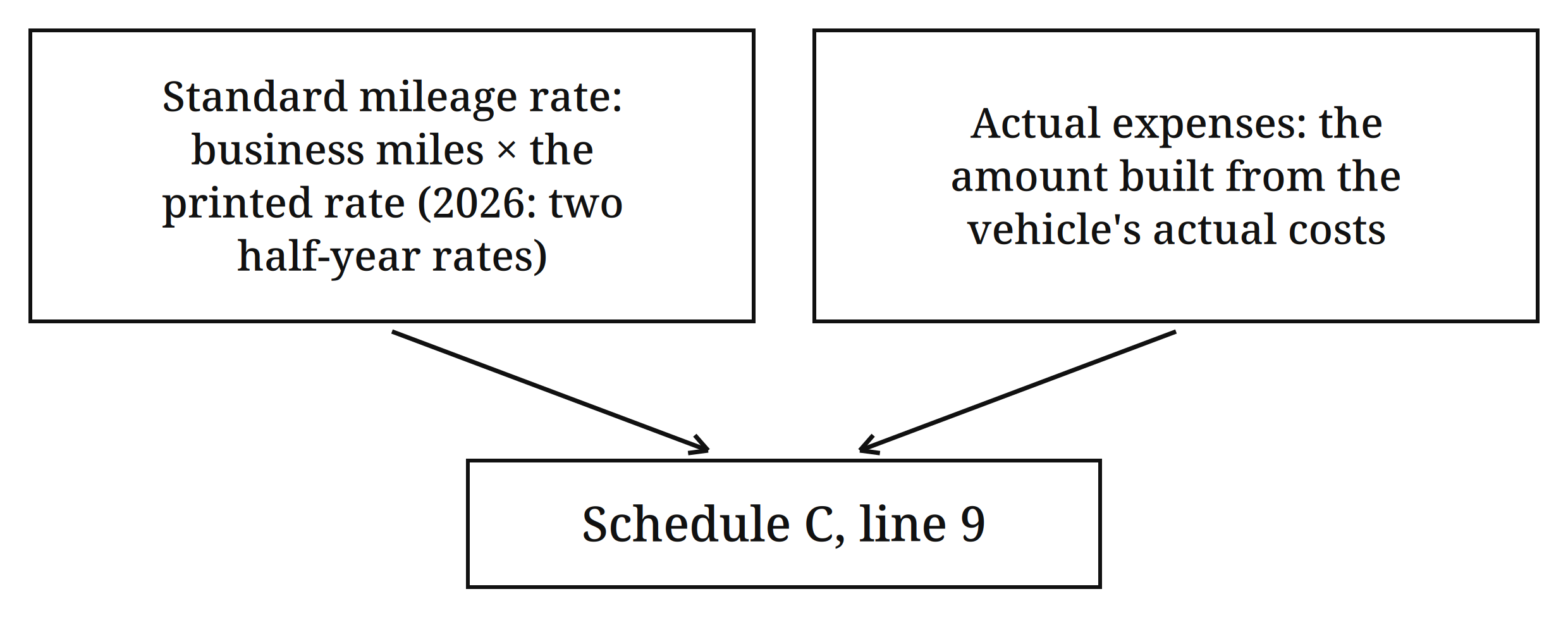
Split card — Standard mileage rate: business miles × the printed rate (2026: two half-year rates); Actual expenses: the amount built from the vehicle's actual costs; both arrows point to Schedule C, line 9.
Now the fork itself, because the standard mileage rate is only one of the two printed ways to build line 9.
Route one is what this article computed: business miles, priced by the IRS's rate — in 2026, by the two half-year rates — and the product is the amount.
Route two is actual expenses: the amount built from what the vehicle actually cost to run for the business during the year. The same line receives it. Schedule C prints one line for it: line 9 takes one entered amount for the vehicle for the year, and Part IV asks for the mileage split behind whichever build produced that amount.
What does not change between the routes is Part IV. When line 9 is claimed and Form 4562 is not required, the vehicle questions are asked — the date placed in service, the three-way mile split, the evidence questions — whichever build produced the dollars.
This site reads both doors and walks through neither. Which build fits a given agent's year turns on records and facts the form alone does not weigh, and the form prints no ranking.
§7What this form does not cover
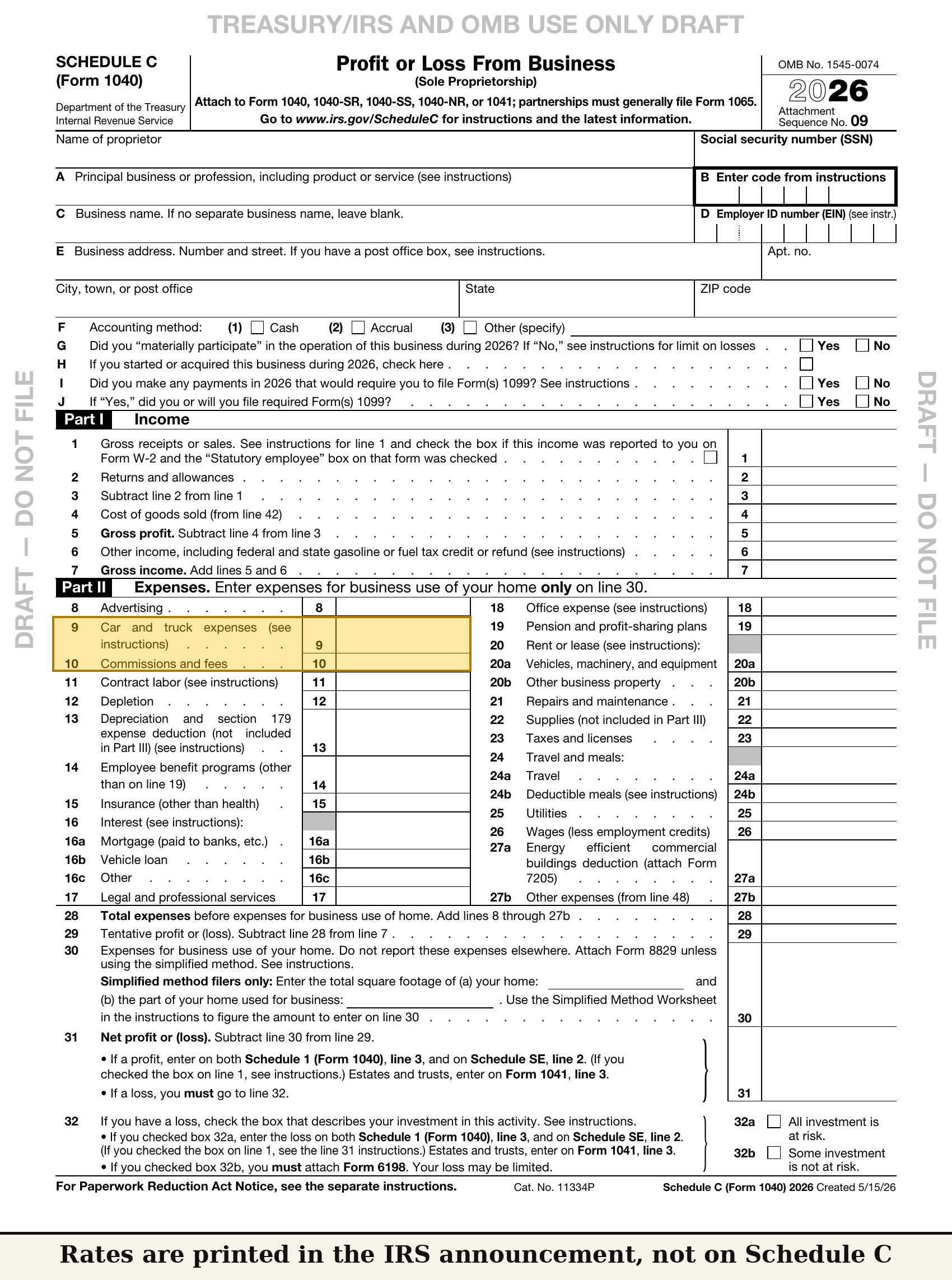
Schedule C full-page draft, greyed, with three callouts: "Rates are printed in the IRS announcement, not on Schedule C" / "Part IV asks about evidence — it does not create the record" / "State taxes: not covered".
What Schedule C does not do, to close the reading.
It does not keep the record for you. Part IV asks whether evidence exists and whether it is written — it does not create the log, and line 9's amount stands or falls on records the form never sees.
It does not price the mile itself: the rates read in this article come from the IRS's announcement for 2026, not from anything printed on Schedule C, and a different tax year carries different printed rates.
It does not decide between the standard mileage build and the actual expense build — both are printed routes into the same line, and this article has ranked neither.
And it does not cover state taxes — this site does not cover state taxes, in this article or any other.
§8Software numbers vs ask-a-human numbers
The split, applied to line 9.
The numbers a piece of software can carry on this one: the two half-year multiplications and their addition — once the business miles for each half of the year are known — and the transfer of the total to line 9.
Numbers and questions to take to a human before you act on them: how a vehicle's miles should be separated when business, commuting, and personal driving run through the same car all year, because the 44a, 44b, and 44c split is an input, not an output; whether the records behind a line 9 claim would satisfy the evidence questions Part IV asks at 47a and 47b; and which of the two builds belongs in your year at all.
That is line 9, as the draft prints it for 2026: one entered amount — $8,599 in this article's example, built from 6,200 miles at 72.5 cents and 5,400 miles at 76 cents — with Part IV's split and evidence questions standing behind it. IRS draft as of October 7, 2026.
Next article: the year's last estimated-tax deadline — the Q4 payment, and the safe harbor lines that decide what it has to be. Article 11
Sources
4 claimsEvery claim above traces to a document, a tax year, a line, and the date it was checked.
-
1
2026 business standard mileage rate splits mid-year: 72.5¢ per mile Jan 1–Jun 30, 76¢ per mile Jul 1–Dec 31
- DOC
- IR-2025-128 / Notice 2026-10, as modified by Announcement 2026-11 (IR-2026-29); IRS Standard Mileage Rates page (registry Section C1)
- YEAR
- 2026
- LINE
- Rate announcement
- CHECKED
- 2026-10-06
-
2
Line 9 is "Car and truck expenses" in Part II; the Part II lines total at line 28, tentative profit is line 29, net profit is line 31, whose text points to Schedule 1 line 3 and Schedule SE line 2
- DOC
- Schedule C (Form 1040) (2026 draft, posted 05/28/2026)
- YEAR
- 2026 draft
- LINE
- Lines 9, 28, 29, 31
- CHECKED
- 2026-10-07 — IRS draft as of 2026-10-07
-
3
Part IV, "Information on Your Vehicle," is completed only if line 9 is claimed and the filer is not required to file Form 4562; line 43 asks the date the vehicle was placed in service; line 44 splits total miles into 44a business / 44b commuting / 44c other; line 45 asks whether the vehicle was available for personal use during off-duty hours; line 46 asks whether another vehicle was available for personal use; line 47a asks whether there is evidence to support the deduction; line 47b asks whether the evidence is written
- DOC
- Schedule C (Form 1040) (2026 draft, posted 05/28/2026)
- YEAR
- 2026 draft
- LINE
- Part IV, lines 43–47b
- CHECKED
- 2026-10-07 — IRS draft as of 2026-10-07
-
4
Craddock: a mileage log that never split business from personal miles, and whose entries conflicted with bank records, led to $14,710 of car and truck expenses being denied in full; §274(d) substantiation blocked any court estimate. Summary Opinion — §7463(b), not precedent; on screen as "In one Tax Court case…"
- DOC
- Craddock v. Commissioner, T.C. Summary Opinion 2023-4; registry Section G1
- YEAR
- Case decided 2023
- LINE
- Holding / usage flag
- CHECKED
- 2026-10-06
Update log
Changes are dated and kept. Old figures are never silently overwritten.